

Yesterday, a subscriber asked a thoughtful question:
“Is the Book of Revelation prophecy, or is it metaphor?”
Many readers wonder whether the Book of Revelation should be interpreted literally or symbolically.
The short answer is both.
Prophecy Communicated Through Symbolic Language
Revelation is definitely prophetic. When you compare the Seals in the Book of Revelation with Jesus’ teachings in Matthew 24, Mark 13, and Luke 21, the sequence of end-time events align — all four apostolic authors describe the same progression of end-time events. Here’s a link to the article explaining this chart that illustrates this parallel progression.

Download the chart:

In Revelation, the apostle John describes these events using symbolic (apocalyptic) language, so it’s usually not literal. For example, in apocalyptic language mountains represent kingdoms or governments (Daniel 2:35, 44–45; Jeremiah 51:25), and waters represent peoples and nations (Revelation 17:15).
These examples illustrate an important principle: the symbols are not the events themselves—they represent real people, nations, and events.
Revelation’s imagery and symbols mainly come from the Hebrew Bible, using symbols that already appeared in earlier books, such as Daniel, Ezekiel, and Zechariah. Readers understand Revelation best when they recognize these earlier biblical references.
Another feature of Revelation that almost-all modern readers overlook is its literary structure.
Why Revelation Is Hard for Modern Readers
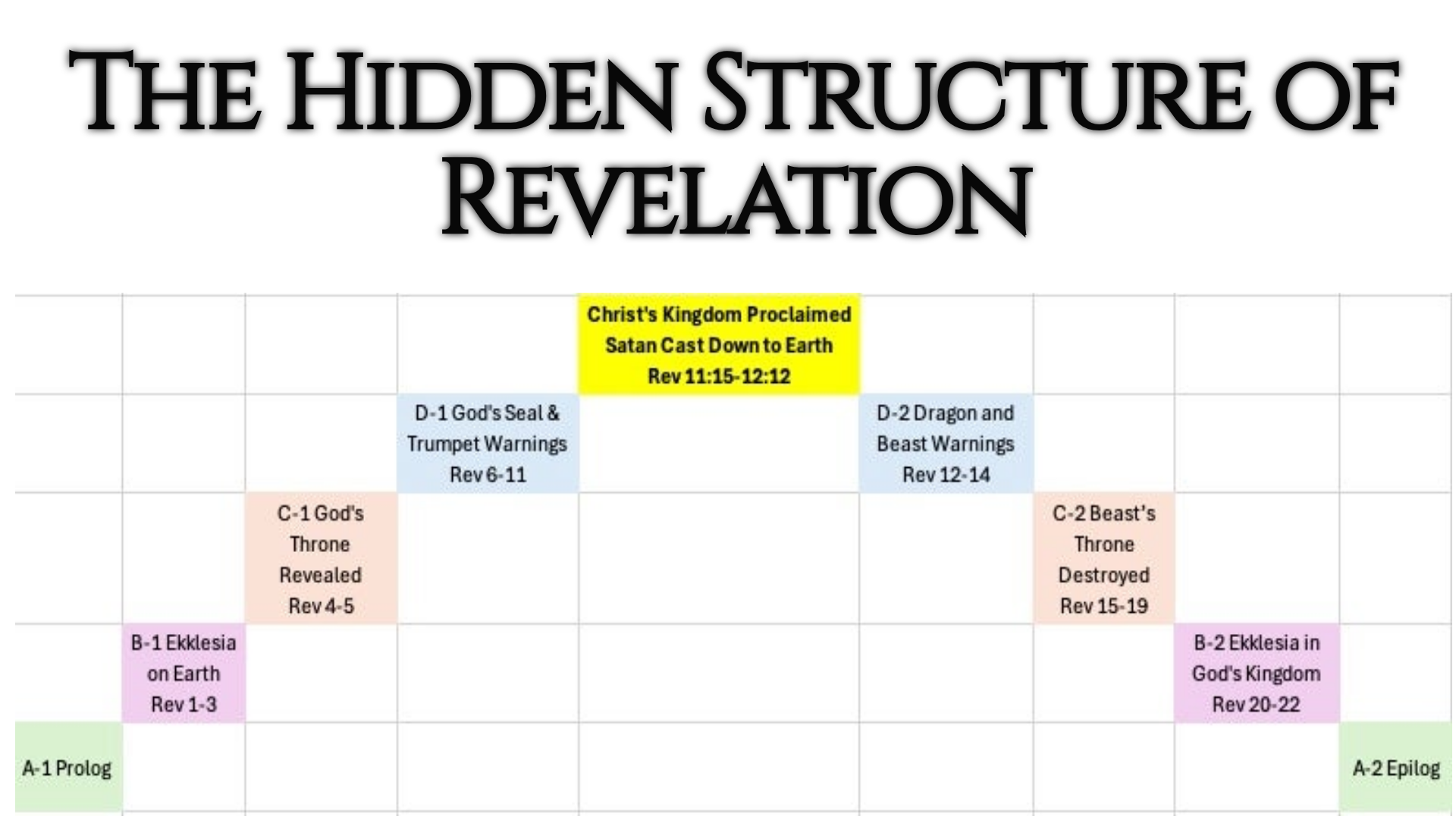
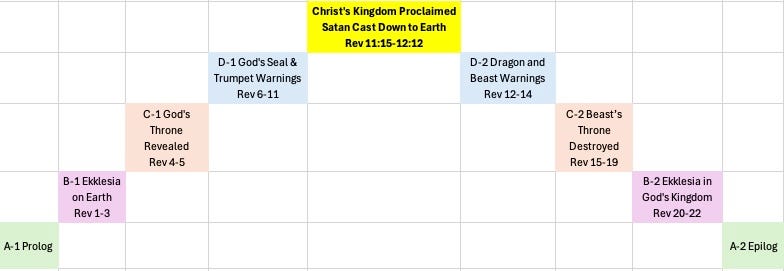
In addition to its heavy use of Old Testament symbolism, Revelation uses a chiastic literary structure — a mirrored pattern of ideas. This structure is unfamiliar to most modern Western readers, who usually try to understand the Book of Revelation chronologically, reading it from beginning to end.
In a chiasm, a book’s themes appear in a mirrored pattern so that the main point sits in the center of the book, rather than at the end.
Here’s a simple example.
In the image below, the green A-1 Prolog is mirrored in the green A-2 Epilog, the Purple B-1 is mirrored in B2, and so on. They all build to a center peak.
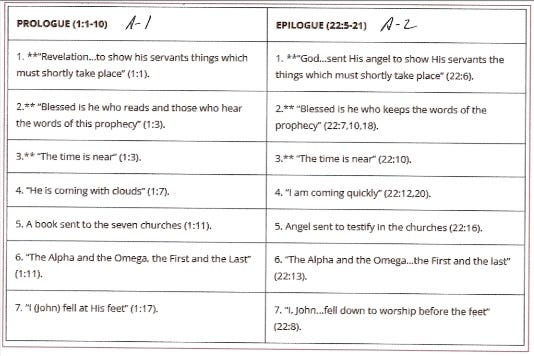
By comparing the details in Revelation’s Prolog (A-1) and Epilog (A-2) below you can easily see how the beginning Prolog is ‘mirrored’ in the ending Epilog.
The Climactic Center of the Book of Revelation
In the chiastic structure of Revelation the climax of the book occurs in its center, between Revelation 11:15–12:12. At this point, ‘great voices in heaven’ announce:
“The kingdom of the world has become the kingdom of our Lord and of His Christ, and he shall reign forever and ever.”
Immediately afterward, Revelation describes a war in heaven and Satan is cast down from heaven to the earth.
This is the decisive turning point of the Book of Revelation. Then, after losing his place in heaven, the dragon wages war against the saints with great fury. The conflict on earth intensifies throughout the remaining chapters until Jesus returns in power and great glory. (Matthew 24:30, Mark 13:26, Luke 21:27)
A Dramatization of Revelation’s Sequence
This sequence—Satan’s expulsion from heaven, the resulting tribulation on earth, and the millennial reign of Christ through His faithful overcomers—forms the central storyline of my Positive Apocalypse trilogy.
The trilogy presents these prophetic themes through a fictional story designed to help readers imagine what these events might look like—and how believers can prepare spiritually and practically—as they unfold in the real world.
You can read the content of the entire trilogy free on the thomasnoss.com website. There, and on Spotify and YouTube, you can also listen to Book 1 (Birth Pangs of the End Times) in a high-quality, multi-voice audio format. Books 2 and 3 will be available in audio soon.
The trilogy is also available to buy in various formats (i.e., eBook, paperback, audio) from your favorite retailer.
Question for You
What part of end-time prophecy has always been the hardest for you to understand?
Reply and let me know. I may cover your question in a future article.